

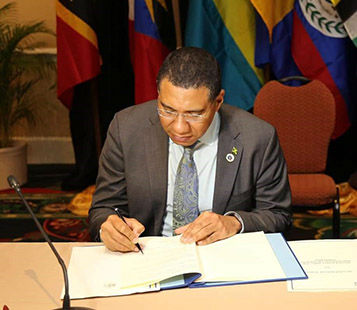
Jamaica is now a signatory to the CARICOM Multilateral Air
Services Agreement (MASA).
The historic signing took place at the 30th Inter-Sessional Meeting
of the Conference of Heads of Government of CARICOM on Wednesday (February 27)
in Basseterre St. Kitts.
The regional MASA will allow for any CARICOM member state to move passengers
and freight by air without having to apply for individual air services rights.
The agreement, therefore, makes it easier for airlines in the region to operate
both passenger and cargo in and out the island.
Additionally, this agreement will allow Jamaica greater flexibility in
negotiating air services agreements with other blocs.
Jamaica has more than 60 air services agreements.
Author: Stephon.johnson@megjc.gov.jm
PM Holness Calls on CARICOM to Build on Successes
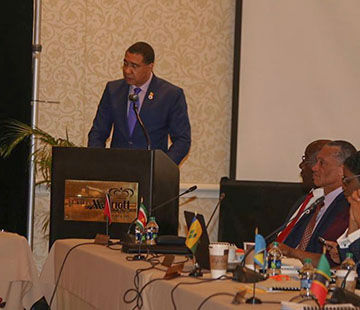
Prime
Minister Andrew Holness has called on CARICOM leaders to act decisively, take
action and build on the successes of the 39th Heads of
Government of CARICOM Conference.
Making his address as the outgoing Chairman of CARICOM in Basseterre St. Kitts
this morning (February 26) Prime Minister Holness said the regional group must
act decisively to strategically seize opportunities that the changing world
circumstance presents.
“During my tenure as Chairman of the Conference, the focus was primarily on
overcoming the inertia which has, for too long, characterized our regional
mechanisms and significantly impaired our ability to simply get things done. It
was also important for us to press for progress on matters which would enable
the average Caribbean man and woman to experience CARICOM in a real and
tangible way, through the implementation of the free movement regime,” said
Prime Minister Holness at the opening session of the 30th Inter-Sessional
meeting in St. Kitts and Nevis.
Under his Chairmanship, Prime Minister Holness led action in responding to the
concerns of fair treatment of CARICOM nationals. The new Procedures on the Refusal
of Entry was adopted and implemented in August 2018.
Additionally, provisions in the Caribbean Single Market and Economy (CSME)
Regime to allow for free movement of persons, CARICOM skilled nationals and
their families through the signature of the Protocol on Contingent Rights was
also done. Ten countries have so far signed that Protocol.
According to Prime Minister Holness, the private sector in the region must spur
growth and development. He called on regional governments to take all necessary
steps to allow for mutual recognition of companies incorporated in a CARICOM
Member State and trim the red tape within our domestic space to provide greater
opportunity for intra-regional investment, cross-border fertilization and
increase private sector interest and collaboration.
Prime Minister Holness emphasized that the region needs a common vision,
an unwavering belief in regional unity and a recognition that the real strength
of the region comes from all of its Member States working together in one accord.
Prime Minister Holness will now pass Chairmanship of the regional body to the
Prime Minister of St. Kitts and Nevis, Timothy Harris who will serve for six
months.
Weathering the Storm with Better Data – Jamaica featured in the Climate Investment Funds 10 Year Anniversary video
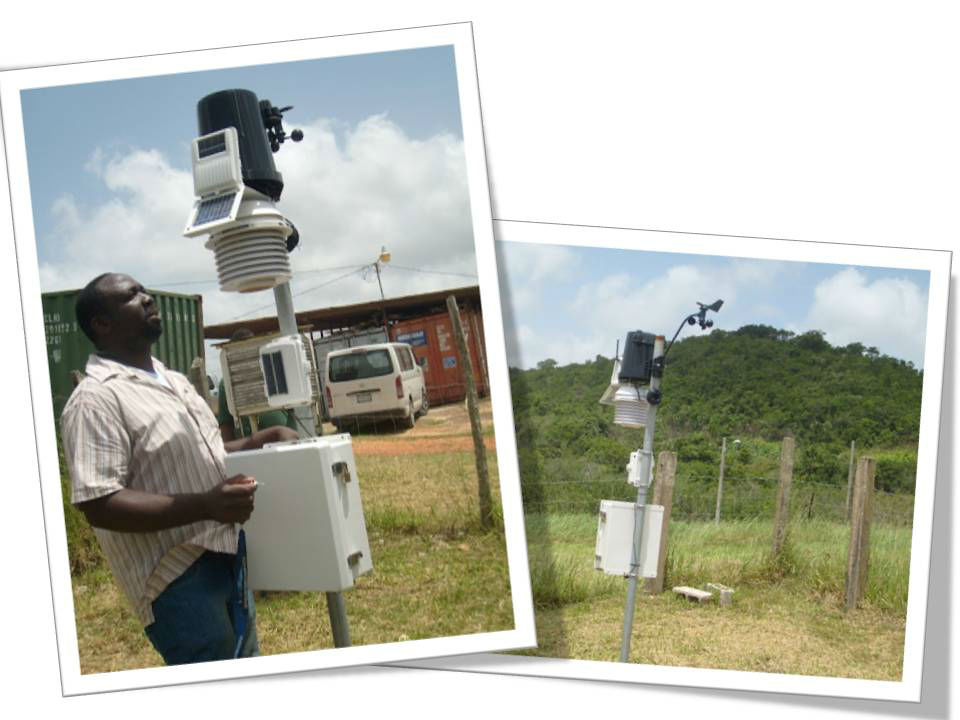
Two of the five projects being implemented under Jamaica’s Pilot Programme for Climate Resilience were selected to be a part of the Climate Investment Funds (CIF) ten year video. Here is one entitled “Weathering the Storm with Better Data”
Reefs Reap Big Rewards – Jamaica featured in the Climate Investment Funds 10 Year Anniversary video

Two of the five projects being implemented under Jamaica’s Pilot Programme for Climate Resilience were selected to be a part of the Climate Investment Funds (CIF) ten year video. Here is one entitled “Reefs Reap Big Rewards”
The Power of 10: the Climate Investment Funds reflects on its journey by sharing stories by those who have benefited from climate finance.

The Power of 10!
Partnerships Do More to Raise More – PM Holness

Prime Minister Andrew Holness is encouraging greater transformation of educational institutions through stronger partnerships particularly past students’ associations.
Acknowledging that the budgetary allocation of Government to schools is limited, the Prime Minister noted that Associations can assist with specific projects at the institutions.
“What the Government gives to the education system, certainly to the traditional high schools is not enough, we will be the first to tell you. What we do try [to do] however is to give you enough to maintain a minimum and uniformed standard across the education system, but schools have by their own resources and effort, have managed to use the little that the Government gives. Raise more to do more and we encourage schools to do that,” said Prime Minister Holness.
The Prime Minister was speaking at the Opening of the Ashenheim Stadium at Jamaica College on Wednesday, February 20.
Jamaica College was gifted an (8) eight lane running track courtesy of past student, Michael Ashenheim and the Ashenheim family who are past students. The facility is a multi-purpose stadium which is a project emanated from the Old Boys Association and the Board of management of the school.
Prime Minister Holness said the donation is in keeping with the “spirit of enterprise and the spirit of philanthropy” in Jamaica and commended the Ashenheim family for their contribution.
“The spirit of enterprise and the spirit of philanthropy is still alive and well in Jamaica and that your family without second thought, decided to make this contribution to the Jamaican people; is something that I personally want to commend you for,” said Prime Minister Holness.
The Prime Minister said he expects great things from Jamaica College.
“I’m expecting that Jamaica College will be producing many athletes now who will probably be performing on the Olympic stage and gaining Jamaica more medals but more than that, it will reach the average student who will now have the facilities to develop their skills,” stated Prime Minister Holness.
In the meantime, the Prime Minister added his commendations to the Old Boys Association.
“Congratulations to Jamaica College, I know it (The Ashenheim Stadium) will serve the students here well. It will serve Jamaica well and I encourage others to make the same kind of contribution,” said Prime Minister Holness.
Chalky Hill & Infant School Receive Water Tank Repairs
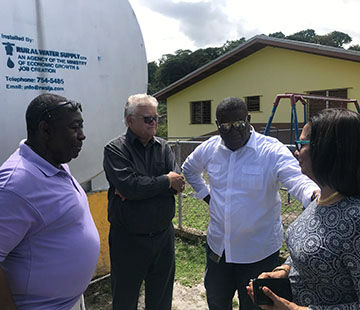
Minister without Portfolio in the Ministry of Economic Growth and Job Creation, Hon. Karl Samuda (2nd from left) discusses recent repairs to the water storage tanks at the Chalky Hill Primary and Infant School in St. Ann with Managing Director of Rural Water Supply Limited, Audley Thompson (left) during a tour of the school on Friday, February 15. They are joined by the NWC’s Regional Manager, Richard Williams (2nd from right) and Member of Parliament for North East St. Ann and Minister of Labour and Social Security, Hon. Shahine Robinson (right).

Minister without Portfolio in the Ministry of Economic Growth and Job Creation, Hon. Karl Samuda (left) celebrates with residents of Hermitage in St. Ann, Member of Parliament for North East St. Ann and Minister of Labour and Social Security, Hon. Shahine Robinson (right) and Director of the Rural Water Supply Limited, Farrah Blake (center) as the community receives piped water for the first time in a commissioning ceremony on Friday, February 15.
Getting Ready for Climate Action
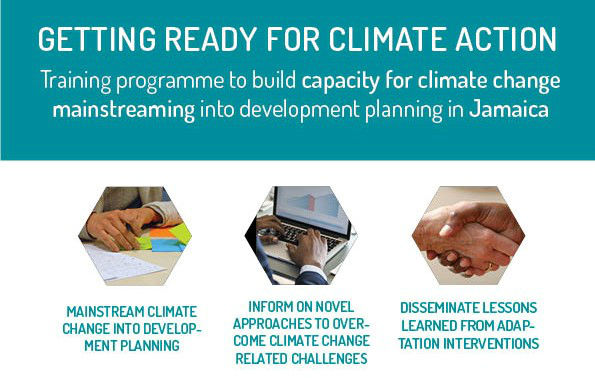
Climate Action Poster
Reduction of plastic waste
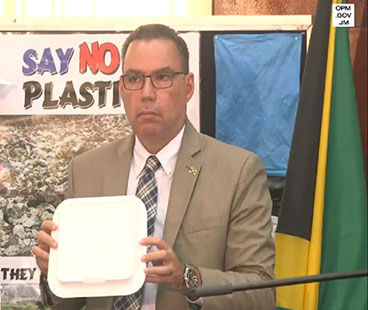
Statement by Hon. Daryl Vaz, MP
Minister without portfolio in the Ministry of Economic Growth and Job Creation
(Land, Environment, Investment and Climate Change)
on
Reduction of plastic waste: Implementation of a Deposit Refund Scheme for Plastic Bottles
in the Houses of Parliament
Tuesday, February 5, 2019
In my Sectoral Presentation to the Parliament earlier this financial year, I indicated to the nation that ‘change is coming’ in relation to the manner in which we, as Jamaicans, treat with our environment and the country’s natural resources. As an indication of that much needed change, I elaborated on, inter alia, the measures that the Government intends to take to minimize the country’s plastic waste generation and management.
The Government, through my Ministry – the Ministry of Economic Growth and Job Creation – has made good on this commitment to the population with the implementation of a ban, on a phased basis, on single use plastics, namely plastic bags of a specified dimension and thickness, plastic drinking straws and expanded polystyrene foam products used in the food and beverage industry, effective January 1, 2019.
Implementation of the ban is governed by two Ministerial Orders, that is, The Trade (Plastic Packaging Materials Prohibition) Order, and The NRCA (Plastic Packaging Materials Prohibition) Order. The public’s response to the ban has been overwhelmingly positive and I would like to thank all Jamaicans for their continued cooperation and support in ensuring that the implementation of this measure is a success.
It is the Government’s intention to continue the public education and awareness programme being undertaken by the National Environment and Planning Agency (NEPA) and the Jamaica Information Service across the length and breadth of the island. Additionally, the relevant regulatory agencies, including the Jamaica Customs Agency, NEPA, the National Compliance and Regulatory Authority and the Bureau of Standards Jamaica will be intensifying their monitoring activities and commence their enforcement actions in the coming weeks. I take this opportunity to reiterate my invitation to the public to submit any queries, suggestions or comments regarding the implementation of the ban on single use plastics to policyonplasticban@nepa.gov.jm or call 876 285 8531.
Change is never easy and can be disruptive, but change is necessary, if we are to ensure a good quality of life for present and future generations of Jamaicans.
The ban on single use plastics while it serves to mitigate some of the country’s waste management challenges, is not a panacea. My colleague, the Minister of Local Government and Community Development, and the National Solid Waste Management Authority (NSWMA), will continue to strengthen the country’s waste management infrastructure and regulatory framework. However, the effective management of the country’s waste is not the responsibility of the Government alone, but also of the private sector, civil society and the individual. Collectively we can realize the much-needed change.
I call upon the private sector, including our micro-, small- and medium-sized enterprises (MSMEs), to seize the opportunity presented through the ban to supply Jamaican designed and produced alternative products for the domestic and regional markets. As you are aware, both the Development Bank of Jamaica (DBJ) and Ex-Im Bank have been requested to support the private sector in making the transition to alternative packaging.
As part of the national programme to minimize plastic wastes, I also made reference in my Sectoral Presentation to the implementation of a deposit refund scheme for polyethylene terephthalate (PET) and high-density polyethylene (HDPE) bottles or plastic bottles. Over fifty per cent (50%) of the plastic waste generated in the island are plastic bottles.
Indeed, approximately eight hundred and fifty (850) million plastic bottles are placed on the local market each year. Unfortunately, only a small percentage of these bottles are collected in the formal waste management system or recycled. As one traverses the country, you will see plastic bottles indiscriminately discarded along major thoroughfares, on open lots/dumps, in gullies, drains and other waterways.
Not only are these bottles unsightly, but they are potential hosts for vectors, such as mosquitoes, and have contributed to the flooding which occurs in several of the main urban centres after heavy rains. This was recently evidenced by the large quantity of plastic bottles seen in Kingston Harbour as well as several of the major drains and gullies within the Kingston Metropolitan Area, Montego Bay and other major towns, after the rains the island experienced two weeks ago. Indeed, each International Coastal Cleanup Day, the country is alarmed at the increasing volume of plastic waste collected along our coasts. Business as usual is not an option. The time for change is now.
The Government has partnered with the private sector in supporting Recycling Partners of Jamaica Limited, through its contribution of J$50M per annum, to facilitate the collection and recycling of plastic bottles. Despite Recycling Partners of Jamaica Limited’s efforts to date, only eleven percent (11%) of the plastic bottles generated are collected. This level of recovery is inadequate and will not ensure the change the Government intends to effect.
Studies have shown that the implementation of a deposit refund scheme or deposit return system for specific categories of wastes, including plastic bottles, can result in a reduction in litter, increase in recycling rates, creation of decent jobs – reduction of poverty – as well as support the Green and Circular economies. It should be noted however that Implementation of a Deposit Refund Scheme is not new to Jamaica. A Deposit Refund Scheme has been successfully implemented by one of the country’s major bottlers for several decades to facilitate the recovery of its crates and glass bottles. Institution of a Deposit Refund Scheme on plastic bottles is therefore an expansion of a ‘tried and true’ approach which the Government has embraced as a viable strategy for addressing the millions of plastic bottles generated in the country each year.
Indeed, The Most Honourable Prime Minister had indicated in his contribution to the 2018/19 Budget Debate in this Honourable House the Government’s commitment to support a Deposit Refund Scheme for plastic bottles. He had also indicated that the private sector had submitted a proposal for the Deposit Refund Scheme which was being considered by the Government. The idea of a private sector-led Deposit Refund Scheme for plastic bottles was also one which was endorsed by the National Partnership Council.
I am therefore happy that the private sector has stepped up to the plate and will therefore provide further details of this private sector-led deposit refund scheme for plastic bottles. The Deposit Refund Scheme will allow for the application of a deposit on plastic bottles placed on the market and a cash rebate to the consumer on the return of these bottles to designated redemption centres across the island. This Scheme will be implemented by a reconstituted Recycling Partners Jamaica Limited.
It is important to note that the participating members of the private sector have instituted a self-imposed Cess of J$1.00 per bottle, which will see an initial private sector investment of J$ 850mn into the program. the initial investment in Recycling Partners will be used to put in place collection points and increase collection capacity by way of truck purchases and fund an expanded education campaign. It is the expectation of the government and should be the expectation of the public that this J$1.00 deposit per bottle will increase the capacity for the collection in place.
In lending its support to this Deposit Refund Scheme, the Government has charged the private sector partners to ensure that: (i) the Scheme is fully operationalized early in the 2019/20 financial year, (ii) the requisite infrastructure is in place to facilitate the effective implementation of the Deposit Refund Scheme, including the siting of redemption centres to allow for ease of return of bottles by consumers, and (iii) a plastic bottle recovery rate of at least eighty-five percent (85%) is achieved within the next four years of implementation of the Scheme.
Additionally, the Deposit Refund Scheme must be supported by a comprehensive and sustained national public education and awareness programme. The Government will monitor the implementation of the Deposit Refund Scheme to ensure accountability and transparency, and if deemed necessary, promulgate legislation to govern the Scheme. Un-refunded deposits will be used to maintain the Deposit Refund Scheme as well as provide support to the NSWMA in its efforts to improve the island’s waste management infrastructure.
Again, the plastic bottles, once collected, present an excellent opportunity for our recyclers to catalyse economic activity, particularly at the micro- and small levels, by designing and producing products for local and regional consumption.
Plastics, by their chemical characteristics, take decades, in some cases thousands of years, to degrade in the environment. Hence, collection of plastics for disposal at landfills is not a sustainable solution in the long-term – particularly in small island developing island states such as Jamaica where land is a scarce and extremely valuable resource.
I have seen and received proposals for the use of these bottles in construction and as inputs in other sectors. The Government of Jamaica would like to see these proposals come to fruition and stand ready to support viable ventures.
The members of this house can be assured that this policy initiative will increase the availability of plastic bottles as raw material for other business initiatives ensuring that there are improved prospects for existing operators and new entrants.
The country must therefore employ creative and sustainable approaches to manage its plastic wastes. It is a social cost, as well as an environmental cost, which we need to factor into our consumption decision. As consumers, we must all take a more responsible approach in the actions we take or not take for our survival and sustainability.
I therefore call upon all Jamaicans to get involved! Reduce, Reuse, Recycle! We all have a responsibility to create the Jamaica we want for ourselves and our children. A new Jamaica is emerging and each and every Jamaican needs to play an active role in its renewal.
New Hotel to Offer Further Boost to Employment

Prime Minister Andrew Holness says the latest Spanish
investment in Jamaica will offer over a thousand job opportunities for
Jamaicans.
Speaking at the groundbreaking ceremony for Ocean Coral Spring Hotel,
Prime Minister Holness expressed gratitude to the Spanish investors for
considering Jamaica as the destination of choice for investment.
“In a few months we will have a new resort here of a thousand rooms, but more
importantly we will have more than a thousand workers. That means that we would
have assisted more than a thousand households in lifting themselves out of
poverty and that Is the shared benefit of investment,” stated Prime Minister
Holness.
The Spanish owned Ocean Coral Spring project is the first in Jamaica and the
English-speaking Caribbean.
Prime Minister Holness underscored that with continued investments such as
Ocean Coral Spring, Jamaica’s tourism will achieve tremendous growth and
benefits for all.
“That is what we mean when we say, we believe in inclusive growth and
prosperity not just the kind of investment that turns over money and increases
profit but the kinds of investments that can turn around lives and increase the
quality of life that people experience. Tourism is doing that in Jamaica,” said
Prime Minister Holness.
In the meantime, the Prime Minister reiterated the need for greater
connectivity in the tourism sector. According to Prime Minister Holness, there
must be more inclusivity of the people associated with the industry.
“What contributes toward growth is when the farmer across the road can get his
or her products into the hotel to be sold and growth is good for the farmer,
it’s good for the tourists and its good for the investor. Ultimately the
product that you are selling, part of it is the beach, sun, sea, the sand, the
safety, the security but ultimately what you are selling is the
hospitality and welcoming face of the people of Jamaica who will embrace your
guests lovingly and what we want is for every single Jamaican to feel that they
are included in the growth and development of this industry which is all about
people,” explained Prime Minister Holness.
The five-star resort located on the beachfront in Falmouth is scheduled to open
its doors in 2019 -2020 winter season with an additional adult only
establishment opening at the end of 2020. The first building will feature 500
rooms while the second aimed at adults only segment will have 440. The resort
will operate in an all-inclusive regime.
 =
=